NovaScribe vs DeepScribe: Human Review or Your Own Eyes?

DeepScribe builds human review and QA into its process. NovaScribe puts you in that role. An honest comparison of review models, pricing transparency, and who each product is built for.

DeepScribe builds human review and QA into its process. NovaScribe puts you in that role. An honest comparison of review models, pricing transparency, and who each product is built for.
Abridge is excellent and sells only to health systems. If you are in an independent practice you cannot buy it. Here is the honest comparison, written by the physician who built NovaScribe.
Freed is cheaper and genuinely good. Here is a specific, current comparison of price, coding, and what each product actually does, written by the physician who built NovaScribe.
A wRVU (work relative value unit) is the standard unit Medicare uses to measure the physician work in a service: the time, skill, effort, and stress it takes to perform it. A quick medication check is worth about 1 wRVU. A moderately complex office visit is worth about 2. Major surgery can be worth 20 or more.
If you’re an employed physician, there’s a good chance wRVUs matter more to your income than the dollars your visits collect, because most productivity-based compensation models pay a fixed rate per wRVU you generate. The wRVUs you get credit for are set by the codes you bill, and the codes you can defensibly bill are set by what’s in your note. Your documentation, not your effort, is what gets counted.
Medicare has priced physician services using the resource-based relative value scale (RBRVS) since 1992. Every CPT code carries three components:
Each component is adjusted for your geographic area, summed, and multiplied by the annual conversion factor to produce the Medicare payment. For 2026 the conversion factor is $33.40 for most practices ($33.57 for qualifying alternative-payment-model participants, a wrinkle your billing team will know). Exact values for any code are in the CMS Physician Fee Schedule lookup tool.
The wRVU is the piece employers use for compensation because it isolates your work from overhead and geography. A 99214 earns the same wRVU credit in Birmingham as in Boston.
Most employed-physician productivity models work like this: your contract sets a dollar rate per wRVU, or a salary with a wRVU target and a bonus above it. Rates vary by specialty and market, commonly in the $40s to $80s per wRVU (MGMA and AMGA publish the benchmarks; your contract states yours).
The arithmetic is unforgiving in both directions. At an illustrative $50 per wRVU:
Those aren’t hypothetical numbers. They’re the wRVU values of the two most common established-patient office visit codes.
| Code | Visit | wRVU |
|---|---|---|
| 99212 | Established patient, straightforward | 0.70 |
| 99213 | Established patient, low complexity | 1.30 |
| 99214 | Established patient, moderate complexity | 1.92 |
| 99215 | Established patient, high complexity | 2.80 |
| 99203 | New patient, low complexity | 1.60 |
| 99204 | New patient, moderate complexity | 2.60 |
| 99205 | New patient, high complexity | 3.50 |
| G2211 | Add-on: visit complexity for longitudinal care | 0.33 |
| 99417 / G2212 | Add-on: each additional 15 minutes of prolonged visit time | 0.61 |
Notice the step from 99213 to 99214: 0.62 wRVUs, a 48% increase in work credit for the same slot on your schedule. The two add-on codes at the bottom of the table are the other lever most physicians leave unpulled; more on them below.
Since the 2021 AMA E/M revisions, office visit levels are chosen by medical decision making (MDM) or by total time, and both live or die in the note. If you managed two chronic conditions, one of them not at goal, reviewed outside records, and adjusted a prescription, that’s the substance of a moderate-complexity visit. But if the note doesn’t capture the outside records you reviewed or the second condition you addressed, and what remains no longer reaches two of the three moderate columns, then unless your qualifying time supports a higher level, you are down to whatever lower level the note does support, and that is what you can defensibly bill. The work happened; the credit didn’t.
Doing level-4 work and writing level-3 notes is common enough to have a name: undercoding. A physician whose documentation under-supports one visit per clinic day is forgoing roughly 155 wRVUs a year (0.62 × ~250 clinic days), which at $50 per wRVU is about $7,750 in personal compensation. That loss comes from documentation gaps, not from seeing fewer patients.
None of what follows is about billing for work you didn’t do. It’s about making sure the note contains the evidence for the work you did. Under the 2021 rules, an office visit level is determined by the higher of two paths, MDM or total time, and you only need to satisfy one. Most physicians default to MDM, so start there.
MDM has three elements. To reach a given level you must meet or exceed that level in two of the three:
The practical consequence: you don’t have to be exhaustive everywhere. If your problems column and your risk column both clearly reach “moderate,” the visit is a 99214 regardless of how much data you reviewed. Knowing which two columns you’ll rely on for a given visit tells you what has to be in the note.
“Addressed” means you evaluated or managed it at this visit. The visit was about the knee, but you also refilled the lisinopril and looked at the home blood pressure log. That’s two problems addressed, not one, and problems addressed are the first column of the MDM table.
Two habits that move this column:
Reviewed-but-undocumented data does not exist for coding purposes. The data column reaches “moderate” if you hit any one of three categories:
The documentation failure here is almost always omission. You looked at the outside echo report, you ordered a BMP, and you ordered a lipid panel. That’s three Category 1 items, but if the note says only “labs reviewed,” a coder can’t count them. Name each test and each external record. Ordering a test and reviewing that same result count once between them, not twice.
The risk column is about the risk of the management options you considered and chose, and it’s the column physicians most often under-document because the decision felt routine.
On some days MDM undersells the visit. A 45-minute counseling visit with an established patient for a newly diagnosed condition may be low-complexity MDM but is a 99215 on 45 qualifying minutes. For a new patient the same 45 minutes supports a 99204. Time-based coding counts your own qualifying time on the date of service: pre-visit chart review, the face-to-face visit, ordering, documentation, and care coordination that day. Time spent on services you report separately does not count toward the E/M. The 2026 thresholds for established patients are 20–29 minutes (99213), 30–39 (99214), and 40–54 (99215); for new patients, 30–44 (99203), 45–59 (99204), and 60–74 (99205).
To use it, the note must state the total time and, ideally, what it covered. One sentence at the bottom of the note does it: “Total time on date of service: 42 minutes, including review of outside records, counseling on treatment options, and documentation.”
G2211 (visit complexity, 0.33 wRVU). Medicare’s add-on for visits where you are the continuing focal point of the patient’s care, or are managing a single serious or complex condition over time. It attaches to any office visit level, so a 99214 with G2211 credits 2.25 wRVUs instead of 1.92. It requires no separate note, but the visit documentation should make the longitudinal relationship visible: reference the prior visit, the ongoing plan, and the follow-up interval. One important exclusion: it generally cannot be billed when the visit carries modifier 25 for a same-day procedure. Medicare does allow it alongside same-day vaccine administration and Part B preventive services such as the annual wellness visit. Commercial payer coverage varies, and whether your employer credits the wRVU depends on your contract, so ask.
Prolonged services (99417 for most commercial payers, G2212 for Medicare, 0.61 wRVU per 15 minutes). When total time runs well past the 99215 or 99205 threshold, each additional 15-minute block is separately creditable. The two codes have different starting thresholds by payer, so confirm with your coder, but the documentation requirement is the same as the time path above: a stated total time.
A synthetic example (no real patient data). Established patient, 20-minute slot, hypertension and hyperlipidemia follow-up, brought a home BP log and a cardiology consult letter.
Note A (thin documentation):
Assessment/Plan: HTN, HLD. Meds adjusted. Labs reviewed. RTC 3 months.
Note B (supports 99214):
Assessment/Plan:
1. Hypertension, not at goal. Home BP log reviewed, average 148/88 over 2 weeks. Increase lisinopril from 10 mg to 20 mg daily. BMP in 2 weeks.
2. Hyperlipidemia, stable on atorvastatin 40 mg. Reviewed lipid panel from 6/2026 (LDL 72, at goal). Continue.
3. Reviewed cardiology consult letter from Dr. Smith dated 7/2026; agree with recommendation for annual echo.
RTC 3 months.
Same encounter, same physician work. Note B reaches moderate in the problems column (one chronic condition not at goal, plus a second stable chronic condition), moderate in the data column (external note reviewed, unique test reviewed, unique test ordered: three Category 1 items), and moderate in the risk column (prescription drug management). Note A describes the same encounter and the same plan, but a coder reading it cannot tell which problem was not at goal, what data you reviewed, or which medication changed. The difference can be up to 0.62 wRVUs, and the physician’s effort was identical.
Every one of these is a documentation habit, not a clinical one. Fixing them costs little or no additional patient time.
Illustrative, at $50 per wRVU and ~250 clinic days:
Run it with your own rate, your own visit mix, and your own contract terms. The point isn’t the specific number; it’s that documentation is a productivity lever that doesn’t require seeing another patient.
This is the problem NovaScribe™ was built around. Because notes are generated from the full encounter conversation, the second problem you addressed, the outside letter you discussed, and the medication you decided to continue are in the draft without you reconstructing them from memory at 6 p.m. Every note on the Professional tier comes with a suggested CPT code and its wRVU estimate, the ICD-10 diagnoses, and an analysis of what the documented MDM supports, including where the documentation could support a higher level. You review, you decide, you sign. The tool’s job is to make sure the note reflects the visit that actually happened.
No. The RVU is the total (work + practice expense + malpractice). The wRVU is only the physician-work component, which is the piece compensation formulas use.
CMS, with heavy input from the AMA’s RUC (Relative Value Scale Update Committee), which surveys physicians about the work involved in each service. Values are published in the Physician Fee Schedule and updated annually.
Only to the extent the work was actually done. Documentation doesn’t create work; it records it. The gains described here come from notes finally reflecting problems addressed, data reviewed, and decisions made that were previously left out. Coding above what the visit supports is fraud, and no documentation tool changes that.
Less directly, but the same documentation drives your E/M level, and the E/M level drives the payment. In 2026, the Medicare gap between a 99213 and 99214 is about $40 per visit. The note carries the same weight either way; only the denominator changes.
wRVUs are how the system counts your work, and the note is the only evidence the system accepts. You already do the work. Make sure the documentation keeps up with it. If you’d like to see wRVU estimates and MDM analysis on your own notes, the free tier includes the full billing analysis on 10 notes a month, no credit card.
An AI medical scribe listens to your patient encounter and drafts the clinical note for you. You review it, edit it, sign it, and move to the next room. Done well, it returns one to two hours of your day. The market now has more than a dozen options, priced anywhere from free to more than $1,000 per provider per month, and the differences between them are not obvious from their homepages.
Full disclosure before anything else: I’m Patrick Proctor, a practicing cardiologist, and I built NovaScribe™, one of the products in this guide. I use it in clinic every day. You should read my product’s entry with that in mind, and I’ve tried to be as fair to the others as I’d want them to be to me. Where a competitor does something better than we do, I say so.
An AI medical scribe is software that records the conversation between you and your patient, transcribes it, and generates a structured clinical note, typically a SOAP note, H&P, or progress note. A smaller number of tools, NovaScribe among them, also generate operative notes from a dictated procedure summary. You don’t dictate the note itself. You just talk to your patient the way you normally would.
These tools exist because documentation has swallowed the workday. A time-and-motion study in Annals of Internal Medicine found that ambulatory physicians spend nearly two hours on EHR and desk work for every hour of direct patient care. A 2024 analysis in Annals of Internal Medicine found primary care physicians now average 2.7 hours of after-hours EHR work per day. That’s the problem every product below is trying to solve.
Five criteria, weighted toward what matters for an independent or small-group practice:
One thing we deliberately did not score: clinical accuracy claims. Every vendor makes them and few publish head-to-head data, so judge note quality yourself, on your own patients, during a free trial. Nearly every tool here offers one.
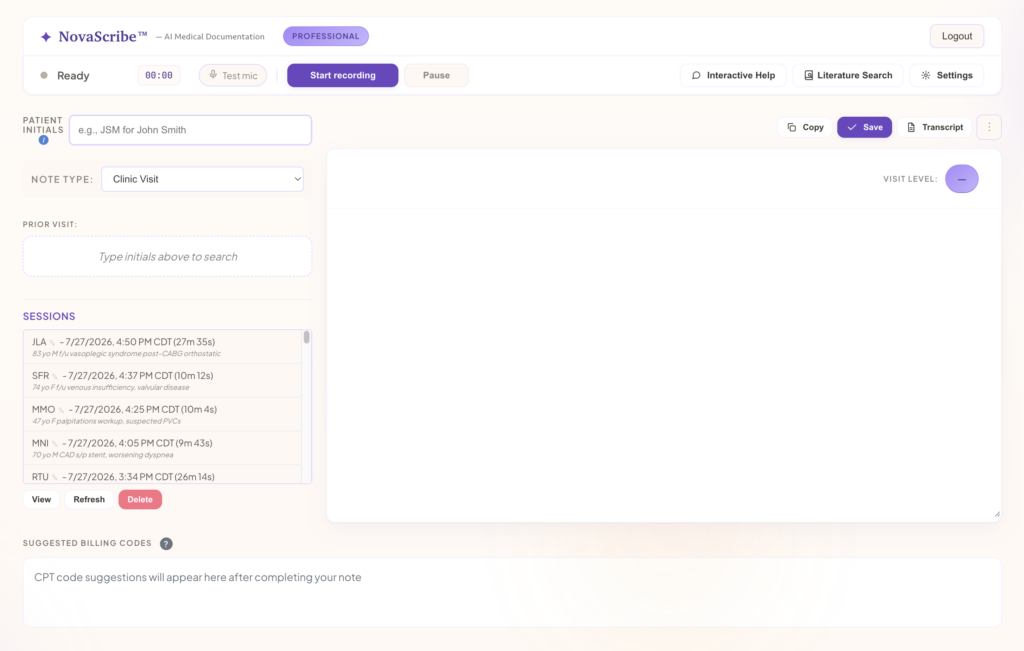
Our product, so apply skepticism accordingly. NovaScribe generates a formatted note in under 20 seconds and works with any EHR by copy-paste, no integration project, no IT department required. You customize your notes with plain-language instructions (“keep my assessments in bullet points,” “always include a lipid trend”) rather than rigid templates. It also generates operative notes for cardiology and orthopedic procedures, which most tools in this price range don’t attempt.
There are two self-serve paid tiers. Basic ($99/month, or $999/year) is unlimited notes with dual-pass transcription, prior-visit patient context and plain-language note customization, without the billing suite; if you’re on a straight salary and just want a note you don’t have to rewrite, that’s the tier to compare against Freed and Heidi. Professional ($229/month) is the differentiator. Every note comes with suggested CPT codes with wRVU estimates, ICD-10 diagnoses, E/M level analysis, and suggestions for where your documentation could support a higher level of medical decision making. If you’re paid per wRVU or on collections, that layer is the reason to pick us over cheaper options.
The free tier includes 10 notes per month with all Professional features and no credit card. Limitations: no direct EHR write-back (copy-paste is the workflow, by design), and we are a small company, so you get founder-level support but not a 24/7 enterprise help desk.
Freed built its reputation on simplicity and price, currently $39 to $119 per month depending on tier, with a 7-day free trial. Setup takes minutes and clinicians generally describe the notes as solid for routine visits. Its Premier tier includes ICD-10 and CPT codes, and it has added specialty templates over time. If you want an inexpensive scribe and do not need wRVU dollar value or E/M level analysis, Freed is a reasonable place to start. See our full NovaScribe vs Freed comparison.
Free for verified U.S. physicians, NPs, PAs, and medical students, with no paid tier at all. It lives inside the Doximity app many clinicians already use, works by copy-paste with any EHR, and can append billing codes to a note on request. For low-volume users, medical students, and anyone who wants to try ambient documentation at zero cost, it is hard to beat.
The tradeoffs are the flip side of free: it’s one feature inside a network and advertising platform rather than a dedicated documentation product, and its customization and billing analysis are lighter than the paid tools here. We wrote a full breakdown in NovaScribe vs Doximity Scribe.
DeepScribe pairs its AI with specialty-specific tuning and offers human-in-the-loop review options. Pricing is quote-based, generally reported in the $350–$500 per provider per month range, with a sales process rather than self-serve signup. It suits practices that want a managed, higher-touch deployment. Our NovaScribe vs DeepScribe comparison covers the details.
Abridge sells to health systems, not individual physicians. It integrates deeply with Epic, has major enterprise deployments, and is priced through enterprise contracts (pricing is not published; third-party estimates run from about $200 to $1,200+ per provider per month). If you’re a CMIO evaluating a system-wide rollout, Abridge belongs on your shortlist. If you’re a solo or small-group physician, you can’t really buy it. Comparison: NovaScribe vs Abridge.
Microsoft merged DAX Copilot and Dragon Medical One into Dragon Copilot in March 2025. It has the deepest Epic integration in the market and the largest installed base. It’s also enterprise-only: no self-serve trial, reseller pricing from roughly $369 per provider per month with a $700 implementation fee and 12-month commitment, and reported quotes running to $600+ for small groups. A NEJM AI study at Atrium Health found time savings per note were real but didn’t translate into system-level productivity gains.
Suki is more than a scribe; it’s a voice assistant that can stage orders, answer chart questions, and write notes directly into Epic, Oracle Health, athenahealth, and MEDITECH. Industry-reported pricing runs $299 per month for Suki Compose and $399 for Suki Assistant, on annual contracts with setup fees. If hands-free EHR control is what you want and the budget supports it, Suki is the most mature option.
Heidi Health offers a free plan with paid tiers from about $30/month. Nabla has free and paid tiers and a strong reputation in primary care. Twofold Health is a budget option around $49/month. All three are credible; none currently offers the CPT/wRVU/E/M analysis layer that defines the productivity-pay use case.
| Product | Typical price/provider/mo | Free option | Billing codes | EHR approach | Buying process |
|---|---|---|---|---|---|
| NovaScribe | $99–$229 | 10 notes/mo, full features | CPT + wRVU, ICD-10, E/M, MDM | Any EHR, copy-paste | Self-serve |
| Freed | $39–$119 | Trial | ICD-10 + CPT (Premier tier) | Copy-paste + integrations | Self-serve |
| Doximity Scribe | Free | Fully free | On request | Any EHR, copy-paste | Self-serve |
| DeepScribe | Not published (est. $350–$500+) | Demo | Yes, varies by plan | Integrations | Sales process |
| Abridge | Not published (est. $200–$1,200+) | No | Enterprise coding tools | Epic-deep | Enterprise sales |
| Dragon Copilot (DAX) | ~$369–$600+ | No | Voice-query coding | Epic-deep | Enterprise sales |
| Suki | ~$299–$399 | Trial | Ambient CPT/E/M | Epic, Oracle, athena, MEDITECH | Sales process |
Try NovaScribe For Free. Ten notes a month, every Professional feature switched on, no credit card.
Pricing reflects published and reseller-reported figures as of mid-2026; confirm current pricing with each vendor.
Start with two questions.
Who’s buying? If the answer is a health system with an IT department and an Epic contract, look at Abridge, Dragon Copilot, and Suki. If the answer is you, look at the self-serve tools: NovaScribe, Freed, Doximity, Heidi, Nabla.
How are you paid? If your compensation runs through wRVUs or collections, a scribe that only writes the narrative solves half your problem. The note determines the code, and the code determines what you’re paid. That’s the case for NovaScribe’s Professional tier, and it’s a fair case for Suki’s coding features at the enterprise level.
Then trial two or three on real patients for a week each. Note quality is personal. It depends on your specialty and on how you talk in the room. No review, including this one, substitutes for reading a draft of your own note.
The established vendors, including everyone named above, operate as HIPAA business associates and will sign a BAA. Ask two sharper questions instead: is your audio used to train AI models, and how long is it retained? (NovaScribe’s answers: never, and audio is deleted within 6 hours.)
Most cover the common outpatient specialties well. Ask about yours specifically. NovaScribe supports 15 specialties, including operative notes for cardiology and orthopedics.
Peer-reviewed evidence suggests documentation tools can affect coding: one 2026 policy brief reports a health system that saw an 11% rise in wRVUs after ambient scribe deployment. Your results depend on whether your current documentation under-supports the codes you could defensibly bill. Our wRVU explainer walks through that math.
You don’t need us to tell you documentation is broken; you live it every clinic day. Any tool on this list will help. The right one depends on who’s paying for it, how you’re paid, and how much editing you’ll tolerate. Trial the free options first, including ours, and let your own signed notes make the decision.
Try NovaScribe For Free. Ten notes a month, every Professional feature switched on, no credit card.
Doximity Scribe is a genuinely good product, and it’s free. If your question is “why would I pay for an AI scribe when Doximity gives me one for nothing,” that’s the right question, and this page is our attempt at an honest answer.
I’m Patrick Proctor, a practicing cardiologist and the founder of NovaScribe™, so I have an obvious interest here. I’ll try to earn your trust the same way I’d want a colleague to: by being specific about what Doximity does well, and specific about what you’d be paying us for.
Doximity Scribe is free ambient documentation inside an app you probably already have. It produces a clean draft note from your patient conversation, works with any EHR by copy-paste, and can add billing codes to a note when you ask it to. For low visit volumes or a first taste of ambient documentation, it’s hard to argue with.
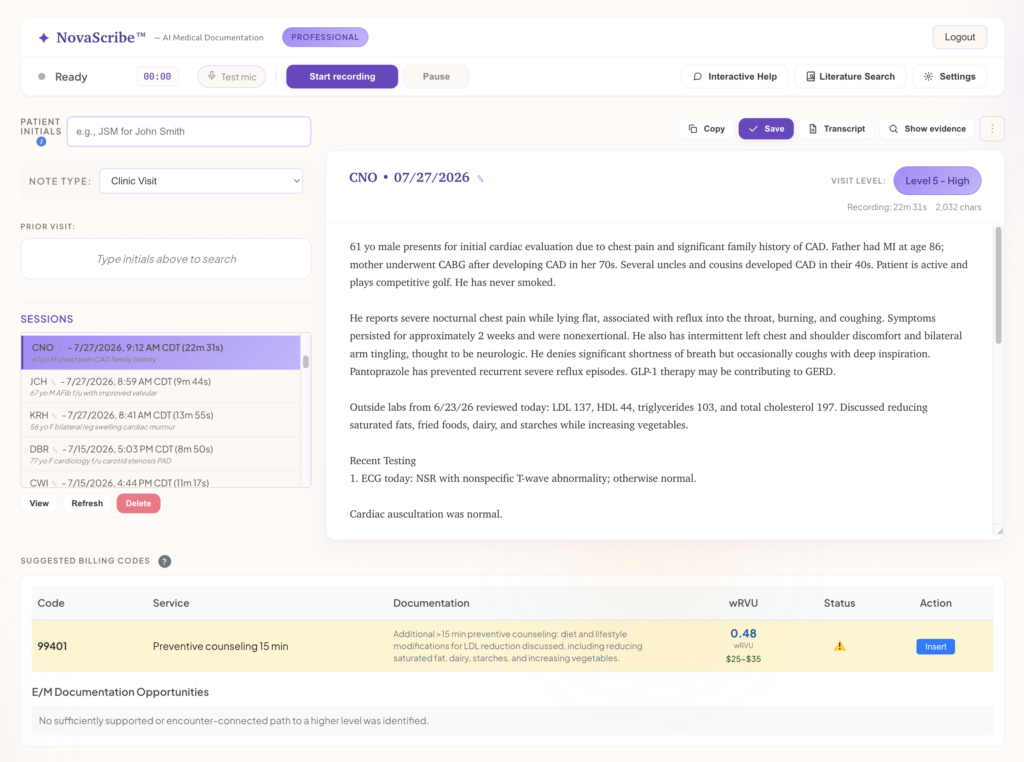
NovaScribe is a dedicated documentation and revenue tool. It starts free (10 notes a month, no credit card), and the paid Professional tier ($229/month) attaches CPT codes with wRVU estimates, ICD-10 diagnoses, E/M level analysis, and medical-decision-making suggestions to every note automatically. If you’re paid on productivity, the real comparison is $229 against whatever your documentation currently leaves unbilled. At 2026 Medicare rates, the gap between a 99213 and a 99214 is about $40 per visit — one supported level increase per clinic day covers the subscription.
Credit where it’s due.
This is the core difference. Doximity Scribe’s job ends at the note; billing codes are an on-request add-on appended to the draft. NovaScribe’s Professional tier treats the note as the input to a second question: what does this documentation support? Every note comes with suggested CPT codes and their wRVU values, ICD-10 codes, an E/M level analysis, and flags where your documented medical decision making could support a different level than you might reflexively pick. Whether that matters depends entirely on how you’re paid. If you’re salaried with no productivity component, it may not. If your compensation runs through wRVUs or collections, it’s the product.
Doximity offers custom note templates and smart-change buttons. NovaScribe takes plain-language instructions: tell it “write my assessment as a numbered problem list,” “always carry forward the ejection fraction,” or “keep patient quotes out of the HPI,” and every future note follows suit. You’re describing your preferences to the software the way you’d orient a new human scribe.
NovaScribe generates a formatted note in under 20 seconds and includes features a free tool has no reason to build: a problem list that persists and evolves across a patient’s visits, prior-visit context, operative note generation for cardiology and orthopedics, and evidence-graded literature search. Doximity Scribe is one feature within a larger clinical networking platform; NovaScribe is only this.
Worth stating plainly, without insinuation: Doximity is a public company whose revenue comes principally from pharmaceutical marketing and health-system hiring solutions delivered through its network. Scribe is free because it strengthens that network. There’s nothing wrong with that model — but it means Scribe’s roadmap serves the platform. NovaScribe’s revenue is subscriptions from physicians, so the roadmap serves the subscriber. Every feature we’ve shipped came from a physician using it in clinic, starting with me.
| Doximity Scribe | NovaScribe | |
|---|---|---|
| Price | Free, no paid tier | Free (10 notes/mo) · Basic $99/mo · Professional $229/mo |
| EHR | Any, copy-paste | Any, copy-paste |
| Note generation | Ambient, templated | Ambient, plain-language customization, <20 seconds |
| Billing codes | Appended on request | CPT + wRVU estimates, ICD-10, E/M level, MDM analysis on every note (Professional) |
| Patient memory | Per-encounter | Problem list and context persist across visits |
| Operative notes | No | Cardiology and orthopedics |
| Audio retention | Per Doximity policy | Deleted within 6 hours; never used to train AI |
| Support | Platform help center | Founder-direct (the person who wrote the code answers support email) |
Try NovaScribe For Free. Ten notes a month, every Professional feature switched on, no credit card.
Choose Doximity Scribe if you see a low volume of documented visits, you’re a student or trainee, your compensation has no productivity component, or you simply want to experience ambient documentation before deciding whether it belongs in your workflow. It costs nothing and it works. We’d rather you use a free scribe than type notes at 9 p.m.
Choose NovaScribe if documentation is a daily, high-volume part of your work and your pay depends on what your notes support. The billing layer is the honest reason to pay us: if undercoded E/M visits are costing you more per month than the subscription — and for most productivity-paid physicians, they are — free stops being the cheapest option.
Our free tier exists for exactly this comparison: 10 notes a month with every Professional feature, no credit card. Run your next clinic morning through Doximity Scribe and the afternoon through NovaScribe, read both sets of drafts, and look at what the billing analysis surfaces. Your own notes will settle it faster than we can.
Try NovaScribe For Free. Ten notes a month, every Professional feature switched on, no credit card.
An AI medical scribe costs anywhere from $0 to more than $1,000 per provider per month in 2026. That range is so wide it’s almost useless, so this guide breaks it into bands, explains what each band actually buys, and walks through the fees that don’t appear on pricing pages. It ends with the arithmetic for deciding whether a scribe pays for itself in your practice.
We sell one of these products (NovaScribe™), so treat this the way you’d treat any vendor’s market guide: check the sources, which we’ve linked throughout.
| Band | Monthly cost per provider | Representative products |
|---|---|---|
| Free | $0 | Doximity Scribe, Heidi (free plan), Nabla (free tier), NovaScribe free tier |
| Budget | $30–$119 | Twofold (~$49), Freed ($39–$119), Heidi paid (from ~$30), NovaScribe Basic ($99) |
| Mid-market | $229–$500 | NovaScribe Professional ($229), Suki ($299–$399), DeepScribe ($350–$500, quoted) |
| Enterprise | ~$200–$1,200+, contracted | Dragon Copilot/DAX, Abridge |
For context on what sits inside each product, our full comparison of the best AI medical scribes covers them one by one.
Several tools offer permanent free access, not just trials. Doximity Scribe is free for verified U.S. clinicians with no paid tier. Heidi and Nabla maintain free plans with limits. NovaScribe’s free tier includes 10 notes per month with all Professional features and no credit card.
Free tiers make sense for low visit volumes, trainees, and evaluation. The limits are volume caps or lighter feature sets; a clinician documenting 15–20 encounters a day will outgrow most of them in the first week, which is what they’re designed for.
This band buys unlimited (or high-cap) note generation with solid quality for routine visits. Freed, the best-known name here, runs $39 to $119 per month depending on tier. NovaScribe’s Basic tier ($99/month, or $999/year) sits at the top of this band: unlimited notes, dual-pass transcription, prior-visit patient context, and plain-language note customization, without the billing suite. What this band generally does not include is billing analysis: you get the narrative note, and coding remains your job. If that’s all you need, Basic and Freed’s upper tiers are the right comparison; the billing layer is what the next band is charging for.
Here the products differentiate. NovaScribe’s Professional tier ($229/month, or $2,299/year) takes everything in Basic and adds CPT codes with wRVU estimates, ICD-10, E/M level analysis, and MDM suggestions to every note. Suki, reported at $299–$399 per user per month, adds voice commands and direct EHR write-back for Epic, Oracle Health, athenahealth, and MEDITECH. DeepScribe quotes per practice, generally reported at $350–$500, with specialty tuning and human-review options. At this level the price covers what happens after the transcript, not the transcription itself.
Dragon Copilot (formerly Nuance DAX Copilot) and Abridge sell through enterprise sales, not self-serve checkout. Reseller listings put DAX-line pricing at $369 per provider per month with a $700 implementation fee and 12-month commitment, with small-group quotes reported at $399–$600+ and large-system blended pricing lower. Abridge does not publish pricing; third-party estimates run from about $200 to $1,200+ per provider per month, contracted through the health system. The product you’re buying in this band is deep EHR integration plus organizational deployment, and the price assumes an organization is paying for it.
Four to ask about before you sign anything:
The traditional alternatives set the ceiling. An in-person human scribe runs roughly $32,000–$42,000 per year per provider, call it $2,700 to $3,500 per month, before benefits and turnover. Virtual scribe services typically run $1,200–$4,000 per month per provider. Against either, even the most expensive AI scribe is a fraction of the cost. The counterpoint: a good human scribe does things software doesn’t, like managing your inbox or queueing orders. The question is whether those extras are worth a 5–20x price difference for your practice.
Two ways to run the math. Use your own numbers, not a vendor’s.
Time. The Sinsky time-and-motion study in Annals of Internal Medicine found ambulatory physicians spend nearly two hours on EHR and desk work for every hour of patient care, and later AMA-supported research put primary care after-hours EHR work at 2.7 hours per day. If a scribe returns even 45 minutes a day, price that hour however you value it: added visits, earlier sign-out, or simply getting your evening back.
Revenue. This one is more concrete. At 2026 Medicare national rates, a 99214 reimburses about $40 more than a 99213. If more complete documentation lets you defensibly support one additional level-4 visit per clinic day that you’re currently coding at level 3, that’s roughly $800 per month at Medicare rates alone, several times the cost of any mid-market subscription. Whether that applies to you depends on whether you’re currently undercoding, which is more common than most physicians assume. Our wRVU explainer covers the numbers. (If wRVUs drive your compensation instead of collections, the same math runs through your wRVU rate.)
For transparency, our full price list: Free ($0, 10 notes/month, all Professional features), Basic ($99/month or $999/year, unlimited notes without the billing suite), Professional ($229/month or $2,299/year, unlimited notes plus CPT with wRVU estimates, ICD-10, E/M and MDM analysis), and Enterprise (contact sales for multi-user administration and volume pricing). No implementation fees, no contracts on monthly plans, works with any EHR by copy-paste.
Because “AI scribe” describes the transcription layer, and transcription is becoming a commodity. The price differences reflect what’s built on top: billing analysis, EHR write-back, voice commands, human review, enterprise deployment.
Yes, within its limits. Doximity Scribe is fully free. Free tiers are the cheapest possible way to find out whether ambient documentation fits how you practice.
A few tools meter usage on lower tiers (that’s what free-tier caps are). Established paid plans in every band above are flat-rate unlimited.
The number on the pricing page is the smallest part of this decision. What matters is the total: fees, contracts, deployment time, and, on the other side of the ledger, the hours and billing capture a good scribe returns. Run the math with your own visit volume and payer mix. If you want to see what our billing analysis surfaces on your actual notes, the free tier exists so you can check before paying anything.