
The Best AI Medical Scribes in 2026: An Honest Comparison From a Cardiologist


An AI medical scribe listens to your patient encounter and drafts the clinical note for you. You review it, edit it, sign it, and move to the next room. Done well, it returns one to two hours of your day. The market now has more than a dozen options, priced anywhere from free to more than $1,000 per provider per month, and the differences between them are not obvious from their homepages.
Full disclosure before anything else: I’m Patrick Proctor, a practicing cardiologist, and I built NovaScribe™, one of the products in this guide. I use it in clinic every day. You should read my product’s entry with that in mind, and I’ve tried to be as fair to the others as I’d want them to be to me. Where a competitor does something better than we do, I say so.
What is an AI medical scribe?
An AI medical scribe is software that records the conversation between you and your patient, transcribes it, and generates a structured clinical note, typically a SOAP note, H&P, or progress note. A smaller number of tools, NovaScribe among them, also generate operative notes from a dictated procedure summary. You don’t dictate the note itself. You just talk to your patient the way you normally would.
These tools exist because documentation has swallowed the workday. A time-and-motion study in Annals of Internal Medicine found that ambulatory physicians spend nearly two hours on EHR and desk work for every hour of direct patient care. A 2024 analysis in Annals of Internal Medicine found primary care physicians now average 2.7 hours of after-hours EHR work per day. That’s the problem every product below is trying to solve.
How we evaluated the different AI medical scribes
Five criteria, weighted toward what matters for an independent or small-group practice:
- Note quality and editing burden. How much do you have to fix before you can sign? That is what matters most. A scribe that saves you typing but costs you ten minutes of editing per note hasn’t saved you anything.
- Speed. How long between ending the encounter and having a draft in front of you?
- Billing support. Does the tool surface CPT codes, ICD-10 diagnoses, and E/M level analysis, or does it stop at the narrative note? For physicians paid on productivity, whether direct revenue or wRVUs, this is where a scribe pays for itself. (More on that math in our AI medical scribe pricing guide.)
- EHR fit. Some tools write directly into Epic or athenahealth. Others work with any EHR by copy-paste. Deep integration sounds better until you see the price tag and the implementation timeline attached to it.
- Total cost. Monthly price, plus implementation fees, contract commitments, and minimum seat counts.
One thing we deliberately did not score: clinical accuracy claims. Every vendor makes them and few publish head-to-head data, so judge note quality yourself, on your own patients, during a free trial. Nearly every tool here offers one.
The best AI medical scribes in 2026
1. NovaScribe: Best for independent physicians paid on productivity
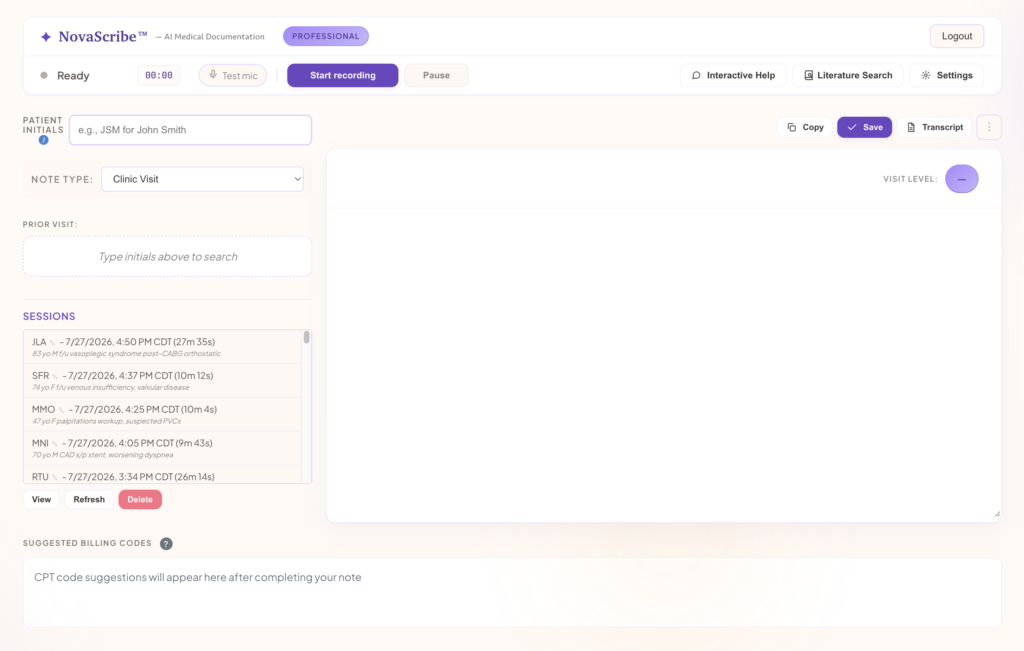
Our product, so apply skepticism accordingly. NovaScribe generates a formatted note in under 20 seconds and works with any EHR by copy-paste, no integration project, no IT department required. You customize your notes with plain-language instructions (“keep my assessments in bullet points,” “always include a lipid trend”) rather than rigid templates. It also generates operative notes for cardiology and orthopedic procedures, which most tools in this price range don’t attempt.
There are two self-serve paid tiers. Basic ($99/month, or $999/year) is unlimited notes with dual-pass transcription, prior-visit patient context and plain-language note customization, without the billing suite; if you’re on a straight salary and just want a note you don’t have to rewrite, that’s the tier to compare against Freed and Heidi. Professional ($229/month) is the differentiator. Every note comes with suggested CPT codes with wRVU estimates, ICD-10 diagnoses, E/M level analysis, and suggestions for where your documentation could support a higher level of medical decision making. If you’re paid per wRVU or on collections, that layer is the reason to pick us over cheaper options.
The free tier includes 10 notes per month with all Professional features and no credit card. Limitations: no direct EHR write-back (copy-paste is the workflow, by design), and we are a small company, so you get founder-level support but not a 24/7 enterprise help desk.
2. Freed: Best-known budget option
Freed built its reputation on simplicity and price, currently $39 to $119 per month depending on tier, with a 7-day free trial. Setup takes minutes and clinicians generally describe the notes as solid for routine visits. Its Premier tier includes ICD-10 and CPT codes, and it has added specialty templates over time. If you want an inexpensive scribe and do not need wRVU dollar value or E/M level analysis, Freed is a reasonable place to start. See our full NovaScribe vs Freed comparison.
3. Doximity Scribe: Best free option
Free for verified U.S. physicians, NPs, PAs, and medical students, with no paid tier at all. It lives inside the Doximity app many clinicians already use, works by copy-paste with any EHR, and can append billing codes to a note on request. For low-volume users, medical students, and anyone who wants to try ambient documentation at zero cost, it is hard to beat.
The tradeoffs are the flip side of free: it’s one feature inside a network and advertising platform rather than a dedicated documentation product, and its customization and billing analysis are lighter than the paid tools here. We wrote a full breakdown in NovaScribe vs Doximity Scribe.
4. DeepScribe: Best for specialty tuning with human review
DeepScribe pairs its AI with specialty-specific tuning and offers human-in-the-loop review options. Pricing is quote-based, generally reported in the $350–$500 per provider per month range, with a sales process rather than self-serve signup. It suits practices that want a managed, higher-touch deployment. Our NovaScribe vs DeepScribe comparison covers the details.
5. Abridge: Best for large health systems on Epic
Abridge sells to health systems, not individual physicians. It integrates deeply with Epic, has major enterprise deployments, and is priced through enterprise contracts (pricing is not published; third-party estimates run from about $200 to $1,200+ per provider per month). If you’re a CMIO evaluating a system-wide rollout, Abridge belongs on your shortlist. If you’re a solo or small-group physician, you can’t really buy it. Comparison: NovaScribe vs Abridge.
6. Microsoft Dragon Copilot (formerly Nuance DAX Copilot): The enterprise incumbent
Microsoft merged DAX Copilot and Dragon Medical One into Dragon Copilot in March 2025. It has the deepest Epic integration in the market and the largest installed base. It’s also enterprise-only: no self-serve trial, reseller pricing from roughly $369 per provider per month with a $700 implementation fee and 12-month commitment, and reported quotes running to $600+ for small groups. A NEJM AI study at Atrium Health found time savings per note were real but didn’t translate into system-level productivity gains.
7. Suki: Best voice-command assistant
Suki is more than a scribe; it’s a voice assistant that can stage orders, answer chart questions, and write notes directly into Epic, Oracle Health, athenahealth, and MEDITECH. Industry-reported pricing runs $299 per month for Suki Compose and $399 for Suki Assistant, on annual contracts with setup fees. If hands-free EHR control is what you want and the budget supports it, Suki is the most mature option.
Also worth knowing
Heidi Health offers a free plan with paid tiers from about $30/month. Nabla has free and paid tiers and a strong reputation in primary care. Twofold Health is a budget option around $49/month. All three are credible; none currently offers the CPT/wRVU/E/M analysis layer that defines the productivity-pay use case.
Top AI Medical Scribes Comparison For Doctors
| Product | Typical price/provider/mo | Free option | Billing codes | EHR approach | Buying process |
|---|---|---|---|---|---|
| NovaScribe | $99–$229 | 10 notes/mo, full features | CPT + wRVU, ICD-10, E/M, MDM | Any EHR, copy-paste | Self-serve |
| Freed | $39–$119 | Trial | ICD-10 + CPT (Premier tier) | Copy-paste + integrations | Self-serve |
| Doximity Scribe | Free | Fully free | On request | Any EHR, copy-paste | Self-serve |
| DeepScribe | Not published (est. $350–$500+) | Demo | Yes, varies by plan | Integrations | Sales process |
| Abridge | Not published (est. $200–$1,200+) | No | Enterprise coding tools | Epic-deep | Enterprise sales |
| Dragon Copilot (DAX) | ~$369–$600+ | No | Voice-query coding | Epic-deep | Enterprise sales |
| Suki | ~$299–$399 | Trial | Ambient CPT/E/M | Epic, Oracle, athena, MEDITECH | Sales process |
Try NovaScribe For Free. Ten notes a month, every Professional feature switched on, no credit card.
Pricing reflects published and reseller-reported figures as of mid-2026; confirm current pricing with each vendor.
How to choose the best AI Medical Scribe for you
Start with two questions.
Who’s buying?
If the answer is a health system with an IT department and an Epic contract, look at Abridge, Dragon Copilot, and Suki. If the answer is you, look at the self-serve tools: NovaScribe, Freed, Doximity, Heidi, Nabla.
How are you paid?
If your compensation runs through wRVUs or collections, a scribe that only writes the narrative solves half your problem. The note determines the code, and the code determines what you’re paid. That’s the case for NovaScribe’s Professional tier, and it’s a fair case for Suki’s coding features at the enterprise level.
Then trial two or three on real patients for a week each. Note quality is personal. It depends on your specialty and on how you talk in the room. No review, including this one, substitutes for reading a draft of your own note.
AI Medical Scribes FAQ
Are AI medical scribes HIPAA compliant?
The established vendors, including everyone named above, operate as HIPAA business associates and will sign a BAA. Ask two sharper questions instead: is your audio used to train AI models, and how long is it retained? (NovaScribe’s answers: never, and audio is deleted within 6 hours.)
Do AI scribes work for my specialty?
Most cover the common outpatient specialties well. Ask about yours specifically. NovaScribe supports 15 specialties, including operative notes for cardiology and orthopedics.
Will an AI scribe increase my revenue?
Peer-reviewed evidence suggests documentation tools can affect coding: one 2026 policy brief reports a health system that saw an 11% rise in wRVUs after ambient scribe deployment. Your results depend on whether your current documentation under-supports the codes you could defensibly bill. Our wRVU explainer walks through that math.
A note from NovaScribe
You don’t need us to tell you documentation is broken; you live it every clinic day. Any tool on this list will help. The right one depends on who’s paying for it, how you’re paid, and how much editing you’ll tolerate. Trial the free options first, including ours, and let your own signed notes make the decision.
Try NovaScribe For Free. Ten notes a month, every Professional feature switched on, no credit card.
